
Welcome back 🙂

Today’s blog post will cover the online experience of a customer.
Understanding the individual nature of customers is fundamental to marketing practice and planning. Research has shown that there are many factors that influence online behaviour and a consumer’s online experience such as convenience, site design and security which can all affect their overall satisfaction as well (Chaffey, D & Ellis-Chadwick 2019).
An important point to note is that by studying the variables associated with a consumer’s experience, digital marketers are able to understand how to increase loyalty and trust through websites and online services. According to Rose et. Al (2011), ‘customer interactions with an organisation’s website creates opportunities for positive experiences that can lead to long-term relationship building’.
The concept of online consumer experience has been widely studied in contexts ranging from service delivery to retailing and tourism (Chaffey, D & Ellis-Chadwick 2019).
Figure 2.9 below shows a framework for understanding the concepts that motivate and influence the online consumer.
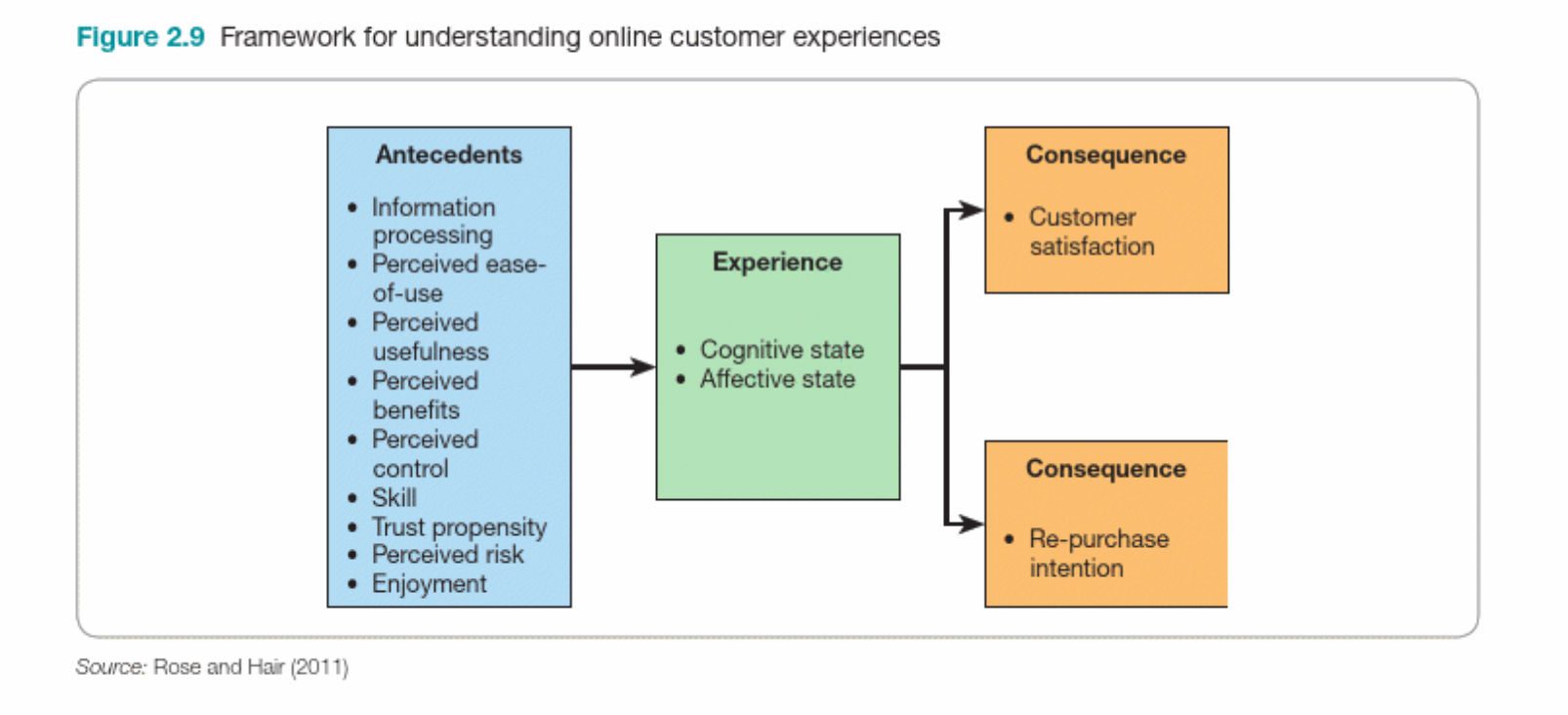
A customer’s past experiences will provide the basis for future evaluations. For example, the antecedents/ background to the online experience can positively or negatively influence the consumer to engage with the digital offer (Chaffey, D & Ellis-Chadwick 2019).
Now let’s break down what each section in the above framework means.
So, starting off with Antecedents:
- Information processing – this shapes how a customer deals with data and information and will shape their future online behaviour. It involves the mental processes and senses individuals use.
- Perceived ease-of-use – the easer a website or mobile site is to use, the more likely a customer will have a positive online experience.
- Perceived usefulness – the extent to which the digital offer aligns with the customers daily life, such as online shopping, booking tickets, banking.
- Perceived benefits – if a customer feels as though they will be rewarded in some positive way by engaging with the digital offer.
- Perceived control – if the customer is a skilled digital technology user, they will feel they are able to function successfully (confidence).
- Skill – the customers’ ability to use the technology to achieve their desired goals.
- Trust and risk – play an important role in how a customer behaves online. Inexperienced online users can often feel vulnerable and fear financial risk, social risk and personal risk. Marketeers should seek to find ways to build trust through developing online relationships.
- Enjoyment – an outcome of a positive online experience.
(Chaffey, D & Ellis-Chadwick 2019).

These eight antecedents can influence how the customer thinks (cognitive state) and feels (affective state) about their online experience (Chaffey, D & Ellis-Chadwick 2019). If a customer has a positive experience this will increase the likelihood of the customer being satisfied. Leading to positive re-purchase intentions (Chaffey, D & Ellis-Chadwick 2019). Furthermore, digital marketeers need to consider not only the functional aspects of an online offer but also the emotional state and past experiences of the customer and how this can affect levels of engagement, trust and loyalty (Chaffey, D & Ellis-Chadwick 2019).

Putting all of the above information into the real-life example of online clothes shopping. As an online shopper myself there are certain aspects which are important to me. These include ease of use of the website (is the layout clear, easy to navigate), aesthetics of the website (does it look nice and professional), availability of customer service (for help if needed- for example, Princess polly has an online forum where you can chat and get live help within business hours) and availability of payment options (ensuring trust and safety eg. through PayPal). All of these factors affect my attitude and behaviour towards the brand and my willingness to shop.

-> Information processing: Princess Polly’s website is enticing with lots of visual images, key words highlighting various sales and promotions on and a contact us pop up at the bottom.
-> Perceived ease-of-use: Princess Polly’s website works easily off both laptop and phone. The layout is clear, and the site is easy to navigate.
-> Perceived usefulness: Princess Polly has a variety of clothes ranging from casual to more dressy items, shoes, festival outfits, makeup and accessories.
-> Perceived benefits: Princess Polly nearly always has discount codes available or sales on. They have a returns policy where you can get a refund -reducing risk for the customer.
-> Perceived control: There is a live chat available for any help if a consumer has any issues using the website. You can make an online account on the website which you can log into and manage at any point.
-> Skill: The website is quite straight forward with everything set out logically- making it easy to use for someone with any technological skill level.
-> Trust and risk: Their social media presence and popularity as a brand can help increase trust. They have a wide range of payment options including PayPal, after pay, credit cards. So customers can pay with an option they feel comfortable with.
-> Enjoyment: The checkout process is quick and the site is easy to use increasing the enjoyment the consumer gets out of the online experience.
Hope you all enjoyed today’s post 🙂
References:
Chaffey, D & Ellis-Chadwick, F 2019, Digital Marketing; strategy, implementation and practice, 7th edn, Pearson, United Kingdom
 Rebecca's Blog
Very clearly explained …. 🙂
LikeLiked by 1 person
Thank you !
LikeLike
informative and well laid out 🙂
LikeLiked by 1 person
Thanks 🙂
LikeLike